Showing posts with label Guest Post. Show all posts

Wednesday, February 13, 2013

The Everyday Cultivating of a Marriage

I am so very excited today to introduce you all to my friend, Jamie.  Jamie is a real-life friend who has a beautiful blog and a big heart for cultivating marriage!  I remember sitting with her and discussing marriage last year with some other ladies from our homeschool support group and leaving so inpsired.  Her enthusiasm is contagious.  And she is here today sharing a bit of her heart for how we can cultivate our marriages!  Oh and by the way, be sure to check out her post on Ways to Bless Your Hubby.  I'm a firm believer that when we work to build our marriage relationship that the whole family is strenghened as a result.  Thanks Jamie for continuing to inspire me!
~~~~~~~~~~~~~~~~~~~~~~~~~~~~~~~~~~~~~~~~~~~~~~~~~
 
Hi, everyone! I’m Jamie from One Blessed Lady and I am absolutely tickled pink to be here.  I just love Heather and all she does to cultivate learning and family here at Cultivated Lives.  Thanks for letting me invade your blog today, Heather.
 
I love that I get share with you some of the ways that my husband and I cultivate our marriage in the everyday.  Like some of you, we homeschool three out of our five with two toddlers in tow, so it would be very easy to let our marriage slip to the backburner. 

We are absolutely not willing to let that happen because marriage happens to be a passion of ours.  Not just our marriage but yours and yours and hers over there.  Marriage is hard enough in real life.  I hope I can help encourage you today.
 
One of the ways that we make sure that our marriage is getting the time and attention it needs is by being fiercely protective of our time together.  It sounds really easy, yes?  {We are all nodding here.}   With our busy schedules, it takes real intention to keep bits of time for each other.  And I’m not just talking about planning date nights, although those are always good.  I’m talking about when you’re living day-by-day, down in the trenches.  Here’s a confession that might shock you… After our kids go to bed, I do nothing except be with my husband.  Did some of you faint?  Of course there are those nights that are the exception, but for the most part, that time is his.  Sometimes we read or watch tv or unload the dishwasher.  I let him decide because it’s his time.  If that means dishes are left in the sink or laundry goes unfolded, so be it.  We also get up early together to have time to pray and share a cup of coffee.  While some mornings it’s hard for me to pull myself out from under the protective layers of covers, it’s always worth it.  When can you squeeze out of your day just for your spouse? 

Another way that we work on our marriage is by cultivating a sense of fun and excitement/adventure with each other.  I really love that I can be my complete and absolute silly self with my hubby and vice versa.  We laugh about the craziest things every time we’re together.  We have dance parties, bubble-blowing contests, races, play “Would You Rather…”, lip sync to every kind of music under the sun and make fun of people on tv.  Every couple is different and being silly might not be your thing.  But what makes you laugh as a couple?  Whatever it is, do it!  Flirt, get your sparkle back, remember why you fell in love in the first place.  Don’t be afraid to be foolish together.  When those tough days come, as we all know they do, being able to laugh will act as a pressure valve between the two of you.   The best sound that your kids can fall asleep to at night is the sound of their parents laughing together.

Thanks again, Heather, for letting me visit over here today.  I hope you have a great Valentine’s Day!

How do YOU cultivate your marriage in the everyday?

Sunday, September 9, 2012

Discovery Learning is...


FUN...

Well, in hindsight anyways!  There is something about the struggle to figure a problem out that gives intense satisfaction afterwards.  Join me over at Tips4Mom as I discuss the trials and triumphs of discovery learning and how important it is for us to take a step back and not do all the mental work for our kids.  Instead we can and should give them the TIME to discover how NOT to do something which is part of the process of discovery.

Learning how to view 'failure' can have a dramatic impact on their life and we have opportunities each and every day to help change our children's perspective that will pay life-long dividends!

See you over there!

Wednesday, September 5, 2012

A Simple "How-to" Guide to Nature Study

{a guest post}

I grew up in the suburbs. My main memories of nature are crows and red-breasted robins. We had cats and a dog. I spent a lot of time indoors watching t.v. I knew things grew out there beyond the sliding glass door but I wasn't terribly interested. Then, in my mid-twenties, I married my Mountain Man and we moved to the island of Corsica, France also known as L'ile de Beaute or Island of Beauty. He loved the outdoors and inevitably, we spent a lot of time there. I began to realize what I had been missing. When we started a family, I knew time spent in nature was going to be a family value. But how exactly? Early on in our homeschool journey, I connected with the values of Charlotte Mason's educational philosophy. I kept coming across the term "nature study" and found it incredibly intimidating. It sounded ideal but I needed some practical application. I find it is more challenging to pass on something you never had yourself. Not impossible just more challenging.

"How-to" Guide to Nature Study

So, I wanted to share a few simple tips to how we do nature study in our home. My hope is the term will transform from feeling intimidating to being feasible and fun for you and your family as it has for us! I find when I participate right alongside my children, pointing out discoveries, wondering about what we've found and even recording them, nature study is a richer experience for all of us. So, don't stand back, jump right on in! Become child-like again! This year, my goals (the keyword here is goals :-)
  • Once a week, take a nature walk and bring home some special discoveries.
  • Once a month, spend an extra hour recording our experience through words and art.

Step Outside

Half the battle is just getting out the door and into nature. Once you're on a trail, observe. Ask questions (mom too!) Recognize beauty. Marvel at what you find. Need a jump-start? Read how our family turns a nature walk into a nature scavenger hunt to inspire observation and stir curiosity. It's easy!

Bring Home a Specimen

I only use the term specimen because it sounds more officially scientific. What I mean is gather a few samples of what you discover. A wildflower, pine cone, or a bug. Bring them home and display them on your nature shelf. I've cleared the top of a bookcase to showcase our weekly finds.

Use Nature Guides

Gather a collection of guides to use. The guides can assist you in answering some of the questions that came up on your walk. Also use them to identify the specimens you brought home. To compliment your nature walks, try Christian Liberty Nature Readers. They can be read independently around a 3rd grade level or you can read them aloud.

 My small collection of nature guides. Find them at garage sales, online or borrow them from the library.
I store ours within reach in a basket on our art shelf.

Record Your Discovery

This year, I've printed this free nature journal template. It can be folded but I put ours flat in a three-ring binder for use at home. Once or twice a month, we'll fill out the form in detail, recording our observations.

 The cover of Samuel's nature notebook.
Once a month, we draw or paint our specimen using any art materials we choose. There is a space for a drawing on the free nature journal template. However, you may choose to buy a special sketch book to accompany your nature study.

 Jesse's first grade drawing of a gumweed

About AshleyBrendle

Ashley is the proud mama of 6 boys (including 1 set of twins). She and her husband live on a small sustainable farm in Oregon where they love to integrate homeschooling, faith in Jesus, family, and ministry into one big, happy life! She believes God wants mothers to thrive in their homes. She writes at Tips4Mom and shares her journey via podcast at ChristianMommyMinute.  I've enjoyed and been challenged by her thoughtful writing and encourage you to check it out!


Related Posts on Cultivated Lives:
Why Nature Walks
How to Nature Walk
Nature Walk Resources
Nature Walking: Books that Inspire
Seven Ways to Take a Walk
 

Saturday, August 25, 2012

Labor Day Learning


I cannot believe that September is right around the corner...  This summer has just sped along.  It hasn't felt as hot this year.  I can't decide it that is because I'm just not pregnant this summer or because we've been creative about enjoying some outdoor time even during these hot summer months.

With Labor Day approaching, I decided to repost these great Labor Day Learning ideas from the archives! Holidays provide a wonderful time for conversation and exploration.  It provides a natural opportunity for real-life learning!  So here is some background information on the holiday and some simple ways to dialogue and explore this holiday.


~~~~~~~~~~~~~~~~~~~~~~~~~~~~~~~~~~~~~~~~~~~~~~
 
Background:
Labor Day is celebrated on the first Monday in September, is a creation of the labor movement and is dedicated to the social and economic achievements of American workers. It constitutes a yearly national tribute to the contributions workers have made to the strength, prosperity, and well-being of our country. Labor Day first began in the 1880's as a day off for the hardworking men and women of America.

Today Labor Day continues to celebrate the efforts of the working person though over the years, it has evolved from a purely labor union celebration into a general last fling of summer. Labor Day grew out of a celebration and parade in honor of the working class by the Knights of Labor in 1882 in New York. The Knights passed a resolution to hold all future parades in September which was selected to reject any identification with May Day, when the Socialists and Communists commemorated the working man.

The Bible has some good things to say about work and labor:

  • Let the thief no longer steal, but rather let him labor, doing honest work with his own hands, so that he may have something to share with anyone in need. Eph. 4:28

  • Lazy people want much but get little, but those who work hard will prosper. Wealth from get-rich-quick schemes quickly disappears; wealth from hard work grows over time. Proverbs 13:4

  • The laborer is worthy of his wages. Luke 10:7
And our countries leaders have said some great things as well:


Here are some ideas to explore this upcoming Labor Day weekend with your family and friends:

  1. Whistle While You Work - Your chores will get done faster if you whistle, chant or sing! Workers in the fields used to set up a steady rhythm and sing about what their jobs entailed to make the time go faster. You can sing one of the following songs or make up your own about the chores you are doing. For instance you can sing about dusting, picking up the (various) toys, making your bed, etc. Make three or four verses that you repeat over and over. Since I am not musical I pick a familiar tune such as The Farmer in the Dell, and write my own lyrics. Here are some classics:
  2. Career Dress Up Day – Ask the children what they would like to be when they grow up. Let them dress up and pretend to do that. I would like to do this as a Labor Day party next year! But you can do it spontaneously this year.
  3. Thank you to a Worker – Write (or draw) a card to send to someone whose work you particularly appreciate – maybe a policeman, or a fireman, your doctor, the grocery store clerk or butcher, or the garbage collector (aren’t all kids fascinated with that job?)
  4. Labor Games – Play charades or Pictionary with these printable “occupation” cards. There are easy ones of the kids, and some harder ones for the teens and adults. With a little work you could set up taboo cards if you prefer.
  5. Read a Book
  6. Have a Discussion – Pick one or more of these questions
    • Is work good? Why or why not?
    • Which is more important, free trade or fair trade? Why?
    • Is all work of equal value to society? Why or why not?
    • (For the kids) What do you hope to do when you grow up? Why? What steps can you take now to help you achieve your goals?
    • (For the adults) What do you like most about your current job? What do you like least? If you could change careers, would you? Why or why not?
    • (For the Grandparents) How has the work force changed in our country during your lifetime?
    • In the US child labor is largely a thing of the past. In other parts of the world, children are still considered a vital part of the work force. Do you think this is good or bad? Why? At what age do you believe children should be allowed to work? What kinds of jobs do you think are appropriate for children? For teens?
  7. Watch a Movie (First three are fun, last two pretty sobering)
    • The Incredibles (All Ages) Mr. Incredible is a hard working man providing for his family. (I know this is a stretch, but I wanted to list one movie for the little ones. :-)
    • Newsies (All Ages) A favorite of our family. My SIL mentioned that the movie makes business the bad guy and unions the good guys. Yeah, but I still like the movie.
    • The Pajama Game (Teens and up) Fun with Doris Day and the unions!
    • Tucker - The Man and His Dream (Older kids and up)
    • On the Waterfront (Teens and up)
    • The Grapes of Wrath (Teens and up)
Colene Lewis
wife, former homeschool mother, grandmother, speaker, curriculum writer (KONOS Russia curriculum) and currently working for Alliance Defending Freedom.
    RELATED POSTS:
    Learning the Value of Work {our chore chart in action}
    Picture Chore Chart Tutorial
    Knights-In-Training {embracing the work of manhood}

Wednesday, July 11, 2012

Oma's Book Club

In continuing our discussion of books and reading, today I have a guest post from my mother, affectionately called "Oma" by her grands.  She is a gifted teacher.  Literature and discussing great books is one of her favorite things to do.  I feel so blessed that she is passing that love on to her grandchildren!

~~~~~~~~~~~~~~~~~~~~~~~~~~~~~~~~~~~~~~~~~~~~~~~~~~~~~~~~~

He knew how to read, loved being read to, read the easy readers, but had not yet discovered the great pleasure of solitary reading, especially reading longer and more complex books.

So Oma’s Book Club was launched.  I wanted to encourage him to devour and savor good books.  This would be more than just getting a reward for reading, we would discuss the books – and thus I would in a natural way teach him the concepts of literature which would cause the enjoyment of good books to soar.  Or at least that was the plan….
When I asked X-man, my 7 year old grandson, if he would like to be in a Book Club with me he excitedly said yes even before I explained it.  (I think his dad had let it slip there might be a treat involved.)

The Plan
     1.       Oma would pick a book to read.

2.       After both reading the book we would have a date to go out and discuss.

The Execution

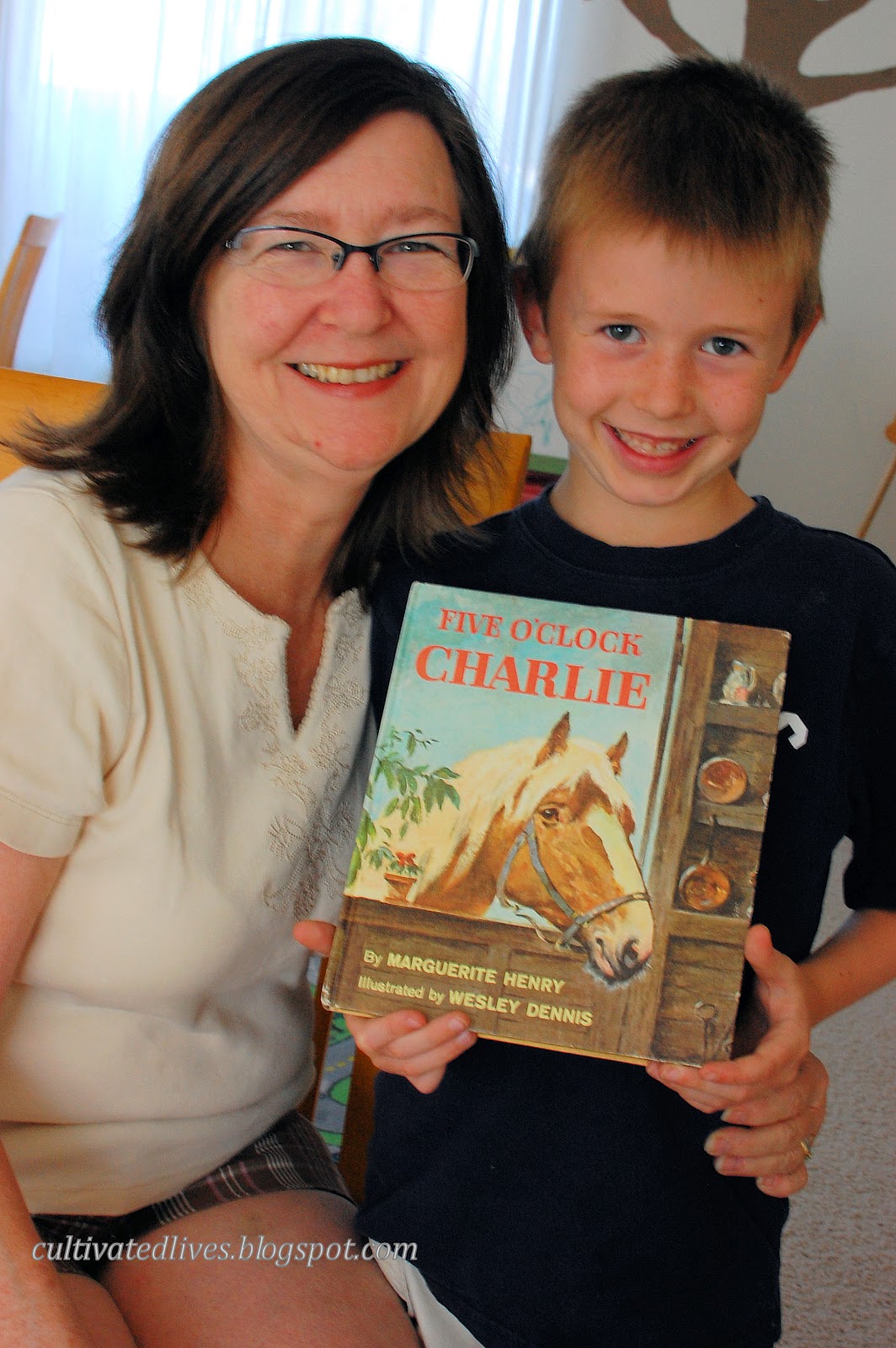
 1.       The X-man is only 7 years old and I wanted the first book to be a success.  He was skeptical of his ability to read a “long” chapter book.  So we started with Five O’ClockCharlie by Marguerite Henry, a 40 page book.  While not a chapter book, this picture book is beautifully written with rich vocabulary, enchanting syntax, and a lovely story of love, life and grace to an older generation.  Definitely a great book for the beginning of our book club.

Twenty-eight year-old draft horse Charlie is retired by Mr. Spinks who is trying to do his horse a favor; but life is boring to Charlie, who misses the days when he and Mr. Spinks would head to the local pub at 5:00 PM sharp for Birdie's fresh apple tarts. One day, Charlie jumps the fence and trots to the pub where he hopes the cheerful Birdie will give him his own juicy tart. Soon, this jaunt is an everyday routine.

2.       After X-man read the book (two or three times), we headed to the frozen yogurt shop for our treat and discussion.

This was to be a real discussion – definitely not a test, nor a lecture, nor a lesson.  But I did have things I wanted to talk about - quite a number of things.  Nevertheless I was also going to be responsive to him – ready to go on a bunny trail if he desired, ready to drop a line of discussion if he seemed lost or bored.  And ready to quit when it seemed natural, rather than when my “list” was completed.

There are many things to discuss about a book: Plot, characters, setting (including both geography & time), themes, vocabulary, literary devices, etc., etc.  You never want to cover everything with every book.  That would be tiresome and stilted. There are future opportunities with the next books.

I started with, “Who is your favorite character?”  And I was ready with the follow up questions of “Why did you like him/her? What was he like? Could you describe her to me?” if needed.  These questions were ready just to get him talking – I did not want him to think I was interrogating him!

X-man told me about Charlie first.  When he described him he left out a few things – one of which I wanted to discuss.  The author described Charlie as having “sad brown eyes and shaggy feathers on his feet.”  I reread the line and we looked at the pictures.  I asked X-man if a horse has feathers on his feet.  He was confused and said, “I guess so.”  So I explained with a laugh that he knew birds have feathers, not horses. I explained that this is a metaphor – a description of an object –in this case the long fluffy hair on Charlie’s feet – that asserts it is, on some point of comparison, the same as another otherwise unrelated object- in this case feathers.

Then X-man wanted to talk about the second character whom he really liked: Birdie, the plump cook at the inn.  I laughed about the name Birdie and asked him if he could imagine anyone naming their child Birdie. He laughed, too, and quoted a line from the book, “She would bounce out of the inn like a cuckoo from a clock.”  I then mentioned that this is similar to the feathered feet of Charlie.  Birdie is not a bird – she is a lady, but she is like a bird.

Now he has not really learned similes and metaphors, but I have broached the subject naturally.  It will not seem as strange next time, and he is building an understanding which will undergird the formal learning he will receive much later.

After we finished talking about the characters – mostly directed by him – I read one particular paragraph out loud.

Quick as flies the people would come swarming.  There were teamsters and tailors, carpenters and cobblers, bankers and barristers, goldsmiths, silversmiths and blacksmiths.   

I did NOT discuss the simile with corresponding verb in the first sentence.  I was being careful not to rub his face in the educational aspect of our book club.  But we did talk about each of the professions.  This is pretty complex vocabulary.  He knew some of them, but not all.  Then I reread the sentence to see if he could hear the pattern.  And as I ready I emphasized:

Teamsters and Tailors, Carpenters and Cobblers, Bankers and Barristers

We talked about alliteration very briefly.  He knows about rhyming and I explained this was similar – and it made the sentence lyrical, or almost musical.  He seemed to understand and commented that it was fun to say out loud. He repeated the work al-lit-er-a-tion and the sentence. 
Of course we also talked about the plot.  I let that discussions just run conversationally at his direction and pace.  X-man also wanted to talk about the illustrations.  I had not planned on talking about them at all.  He had thought about them and shared his insights with me!

The theme of the story is that we all need meaningful work, that we need to treat everyone with respect, and that no one is too old to have a rich meaningful life.  If X-man brought it up we would follow his bunny trail.  But I knew going in that I would not chose to discuss it. 

Many times morals and themes are best caught by the story rather than taught by the teacher.  I did discuss it with his mother in case she has the opportunity to catch him exhibiting the positive character traits – then she can comment that he is behaving like Charlie or Birdie. 

Our first book discussion was a great success.  I spent a few hours tracking down the next book I wanted to read. 

My goals?  Good books – good both from a literary standpoint and morally.  A variety of genres and authors. Books that are increasingly challenging while not being overwhelming. 
My next choice?  TheBox Car Children.

Oma’s Book Club… to be continued…..

Colene Lewis
wife, mother, grandmother, speaker, curriculum writer (KONOS Russia curriculum) and currently working for Alliance Defending Freedom.

Related Posts on Literacy and Reading:


Wednesday, May 30, 2012

Crafting Play - Cultivating Learning

Hello everyone!  Today I'm guest blogging over at One Blessed Lady and sharing about how a few key props or costumes can really enhance learning through dramatic play!

Click on over to read!

I'll be back Friday morning with the next Daily Outdoor Challenge update! :)

Tuesday, May 8, 2012

Remembering Sendak

 As we read of the passing of Maurice Sendak, it brought back memories of a post that my mom wrote for an old blog of ours and I thought I would repost it.

Makes me want to go upstairs right now and check on my sleeping 'wild things' - all four of them!

~~~~~~~~~~~~~~~~~~~~~~~~~~~~~~~~~~~~~~~~~~~~~~~~~~~~~~~~~~~~~~~~~~~~

Imagine-Lit: Where the Wild Things Are
{originally posted 8/16/2008}


When this book first came out most adults did not like it.

I LOVED IT.

I had a wild thing and I loved the unseen mom in this book because
  • she enjoys her wild thing
  • she named him wild thing
  • she hung his wild picture
  • she made his wild costume
  • she encouraged his imagination
  • she disciplined him with love
  • she guided him into conquering his wild impulses
  • she loved him best of all… and he knew it.
I related to her and I rejoice when Max returns to his mom and to her unwavering care and love.
It was with great joy that I gave a copy of this book to my wild thing, who now has wild things of her own. 
Colene Lewis
wife, mother, grandmother, speaker, curriculum writer (KONOS Russia curriculum) and currently working for The Alliance Defense Fund.

Sunday, September 4, 2011

Labor Day Learning Fun

{whistle while you work}

I hope you all are having a fabulous Labor Day weekend.  My boys are so very excited to have their daddy home for an extra day this weekend...  As we enjoy time together as a family, we also plan to take some time to learn about the origins of Labor Day and commemorate the day a bit.  All of life is full of learning opportunities, isn't it?!?!?

The older I get, the more I see that I am becoming more and more like my mother.  Speaking of my mother, this very creative woman has put together a fabulous resource for having some fun while turning our attention to what Labor Day is all about.

{Huge sigh of relief}  Because my creative juices ebb and flow pretty erratically over here at this point in the pregnancy.  I just keep telling myself 4(ish) more weeks. 

 So today, she is 'guest posting' and sharing her fabulous ideas for the whole family from the littlest to the grandparents!  ENJOY!

~~~~~~~~~~~~~~~~~~~~~~~~~~~~~~~~~~~~~~~~~~~~~~
Background:
Labor Day is celebrated on the first Monday in September, is a creation of the labor movement and is dedicated to the social and economic achievements of American workers. It constitutes a yearly national tribute to the contributions workers have made to the strength, prosperity, and well-being of our country. Labor Day first began in the 1880s as a day off for the hardworking men and women of America.

Today Labor Day continues to celebrate the efforts of the working person though over the years, it has evolved from a purely labor union celebration into a general last fling of summer.  Labor Day grew out of a celebration and parade in honor of the working class by the Knights of Labor in 1882 in New York. The Knights passed a resolution to hold all future parades in September which was selected to reject any identification with May Day, when the Socialists and Communists commemorated the working man.

The Bible has some good things to say about work and labor:      
  • Let the thief no longer steal, but rather let him labor, doing honest work with his own hands, so that he may have something to share with anyone in need. Eph. 4:28
  • Lazy people want much but get little, but those who work hard will prosper. Wealth from get-rich-quick schemes quickly disappears; wealth from hard work grows over time. Proverbs 13:4
  • The laborer is worthy of his wages. Luke 10:7
And our countries leaders have said some great things as well:
  • A wise and frugal government, which shall leave men free to regulate their own pursuits of industry and improvement, and shall not take from the mouth of labor the bread it has earned -- this is the sum of good government.- Thomas Jefferson
  • Work is not a curse, it is the prerogative of intelligence, the only means to manhood, and the measure of civilization. -Calvin Coolidge
So what to do on labor day – especially with your family and friends:
  1. Whistle While You Work - Your chores will get done faster if you whistle, chant or sing!  Workers in the fields used to set up a steady rhythm and sing about what their jobs entailed to make the time go faster.  You can sing one of the following songs or make up your own about the chores you are doing.  For instance you can sing about dusting, picking up the (various) toys, making your bed, etc. Make three or four verses that you repeat over and over.  Since I am not musical I pick a familiar tune such as The Farmer in the Dell, and write my own lyrics.  Here are some classics:
  2. Career Dress Up Day – Ask the children what they would like to be when they grow up.  Let them dress up and pretend to do that.  I would like to do this as a Labor Day party next year!  But you can do it spontaneously this year.
  3. Thank you to a Worker – Write (or draw) a card to send to someone whose work you particularly appreciate – maybe a policeman, or a fireman, your doctor, the grocery store clerk or butcher, or the garbage collector (aren’t all kids fascinated with that job?)
  4. Labor Games – Play charades or Pictionary with these printable “occupation” cards. There are easy ones of the kids, and some harder ones for the teens and adults.  With a little work you could set up taboo cards if you prefer.
  5. Read a Book
  6. Have a Discussion – Pick one or more of these questions
    • Is work good? Why or why not?
    • Which is more important, free trade or fair trade? Why?
    • Is all work of equal value to society? Why or why not?
    • (For the kids) What do you hope to do when you grow up? Why? What steps can you take now to help you achieve your goals?
    • (For the adults) What do you like most about your current job? What do you like least? If you could change careers, would you? Why or why not?
    • (For the Grandparents) How has the work force changed in our country during your lifetime?
    • In the US child labor is largely a thing of the past. In other parts of the world, children are still considered a vital part of the work force. Do you think this is good or bad? Why? At what age do you believe children should be allowed to work? What kinds of jobs do you think are appropriate for children?  For teens?
  7. Watch a Movie (First three are fun, last two pretty sobering)
    • The Incredibles (All Ages) Mr. Incredible is a hard working man providing for his family. (I know this is a stretch, but I wanted to list one movie for the little ones. :-)
    • Newsies (All Ages)  A favorite of our family.  My SIL mentioned that the movie makes business the bad guy and unions the good guys.  Yeah, but I still like the movie.
    • The Pajama Game (Teens and up)  Fun with Doris Day and the unions!
    • Tucker - The Man and His Dream (Older kids and up)
    • On the Waterfront (Teens and up)
    • The Grapes of Wrath (Teens and up)
Colene Lewis
wife, mother, speaker, curriculum writer (KONOS Russia curriculum) and currently working for The Alliance Defense Fund.

Thursday, July 28, 2011

Art vs. Crafts

photo credit: my sister.

Since we just finished up a series on Open-Ended Play, I wanted to share some thoughts my sister had on "Art vs. Craft".  In the early years especially, I've traditionally been a huge fan of open-ended art.  And I still am.  But as she points out 'craft' has its place too in the life of a young child.  She is guest blogging today and sharing her thoughts on the topic.  Enjoy the read.

~~~~~~~~~~~~~~~~~~~~~~~~~~~
I read a fascinating article discussing the difference between art and crafts last week, and the importance of art in child development. The article defines art as activity that “encourages a child’s originality and unique expression with an unknown outcome.” By contrast, crafts “involve the child’s reproducing an adult’s idea, while following directions to make a specific ‘thing’ – a known outcome.” Think of a rabbit of cotton balls on construction paper, modeled exactly off of a teacher’s version, verses a free-form collage of cotton balls.

Did you know there was a difference between art and crafts? The distinction is new to me, but it makes sense.

The author elevates art over crafts. She asserts that crafts do not require “original thinking” and “are meant to be useful or practical, or to reinforce a fact or learning theme” while “art is a unique form of creativity that inspires each individual child to be original and inventive and to think for himself.” That’s true to a great degree. And the culture tends to favors product over process. So most children think art is coloring books and crayola crayons, and languish for lack of freedom to paint abstractions with giant brushes and sidewalk paint in the driveway or erect cities of great splendor from toothpicks and marshmallows.

On the flip side, art without crafts is nothing. Crafts provides the opportunities to develop specific skills that can be bent and used during artistic endeavors. Indeed, much of art instruction is skill development through crafts. In grade school, my mom taught me the concept of perspective and how to draw a cube and a cylinder by copying her sketches while my aunt taught me the mathematical proportions of the human face for purposes of portraiture. Both my art teacher in junior high and my instructor at college spent most of their classes having us replicate other artwork or still-life arrangements. Public galleries are often scattered with art students bent over easels, copying the work of the masters. The point is not to be another Rembrandt; rather, a close study of Rembrandt can lend something to the quality and character of the student’s original work.

The conflict, then, is not between art and crafts, but the distortions that come from emphasizing one over the other. Art and crafts are equal partners in the creative process. For my own part, I’m now more conscious of the projects I give Evangeline. The majority of her creative work requires only her imagination plus art supplies. But I try to sneak in a couple projects a week where I’m drawing or painting or building something and allowing her to observe and copy if she likes, or even providing her printable coloring sheets where she gets to follow the lines of a third-party artist.

(Photo: The other day Evangeline asked for scissors and construction paper. Then a glue stick. A while later she brought her “boat” over to show me.)


Bethany:
attorney turned stay-at-home mom of two kiddos (3.5 years and 2years old), loving wife, crafter/artist extraordinaire, fashion consultant (to me, anyways), best-friend sister to two of us!

Friday, October 1, 2010

Food sculptures

All of this talk of food, nutrition and teaching our children, reminded me of something my sister had written a while back.  She has graciously agreed to 'guest post' here.  What a powerful lesson in modeling to our children and yet also holding expectations lightly and allow them to express themselves artistically in an open-ended, oftentimes abstract way.  Finding that balance between modeling how to do something and allowing them to explore and discover for themselves is an art.  This is definitely a skill I'm still working on...


I'm also reminded to be grateful for the mothers who have gone before us and the wisdom they have to offer.  I have several women like this in my life and am better off because of their love, insight and friendship.

~~~~~~~~~~~~~~~~~~~~~~~~~~~~~~~~~~~~~~~~~~~~
When I read about this activity on Heather’s blog, I wanted to do it immediately in spite of E’s age (2.5 years old) and inability to accurately recreate the play-doh food, and I was encouraged by a note my mother-in-law sent me around that time that said,
“When I saw the precious picture of Evangeline painting, I instantly thought of something I learned somewhere in my reading when Arthur was new. It is really nothing you haven’t heard but made me keenly realize the power of modeling in a child’s development. The story, as well as I can recollect, was about a classroom where the teacher was instructing her students to make simple clay structures like balls and snakes and coiled baskets. One of her students wasn’t engaged but she dismissed it, thinking it was due to his learning disabilities. Later, she brought in a guest artist who spent a fair amount time in front of the children, not talking about his work, but actually working in the clay in a masterful way. The mentally slow child drank it all in, and soon got another opportunity to work in clay again without the previous parameters. Everyone was amazed at how he fashioned the clay with confidence and dexterity, though obviously as a novice and not a master. He had picked up some technique but more so, passion. Now this only happened because the boy had an inclination toward 3-D expression, granted. But how vital it was for him to see a master at work to even begin to unlock his potential.”
I went ahead with the activity, and it actually morphed into a delightful time for the both E and me. First, I pulled out our real-food samples. We talked about each one, whether it was a fruit or vegetable, it’s color and it’s shape. Then, E selected the color-appropriate play-doh and I made replicas and she made abstract versions of the produce. We discussed the difference between real and fake food, and she even sneaked a taste of the play-doh to prove to herself it was fake. We ended with a mini feast of the real stuff.


Bethany
attorney turned stay-at-home mom of two kiddos (2.5 years and 15 months old), loving wife, crafter extraordinaire, fashion consultant (to me, anyways), best-friend sister to two of us!